

Are you a second-language professional in the public or non-profit sector? Your words don’t just describe your work. They ARE your work. Mastering these nuances is the key to moving from “functional” English to “influential” English.
In the private sector, language is often about persuasion: selling a product or a lifestyle. But in the public and voluntary sectors, language is about impact and partnership, whether you are a Policy Analyst, a Support Worker, or a Charity Manager.
Here are three reasons why your choice of words defines your professional presence.
1. The Power of Prepositions: “For” vs. “With”
Small words carry heavy weight in social change. Consider the difference in these two statements:
- I design services for the community.
- I design services with the community.
The first implies a top-down, “saviour” approach. The second signals co-production: a core value in modern UK public service. One sounds like a provider; the other sounds like a partner. By changing one tiny word, you signal your entire professional philosophy.
2. The Inclusion Compass: Reflecting Dignity
Terminology in the UK evolves to reflect dignity and the “social model” of support. For example, we no longer say “handicapped”; the accepted professional term is “disabled person.”
Staying current with these shifts isn’t just about being “politically correct”; It is a professional competency. It shows you are a modern, culturally competent professional who respects the identity of the people you serve.
3. Word Stress Defines Your Priority
In our sector, we are often the bridge between an organisation and the community. Because we deal with people’s lives, the feeling we convey and our sense of urgency matter.
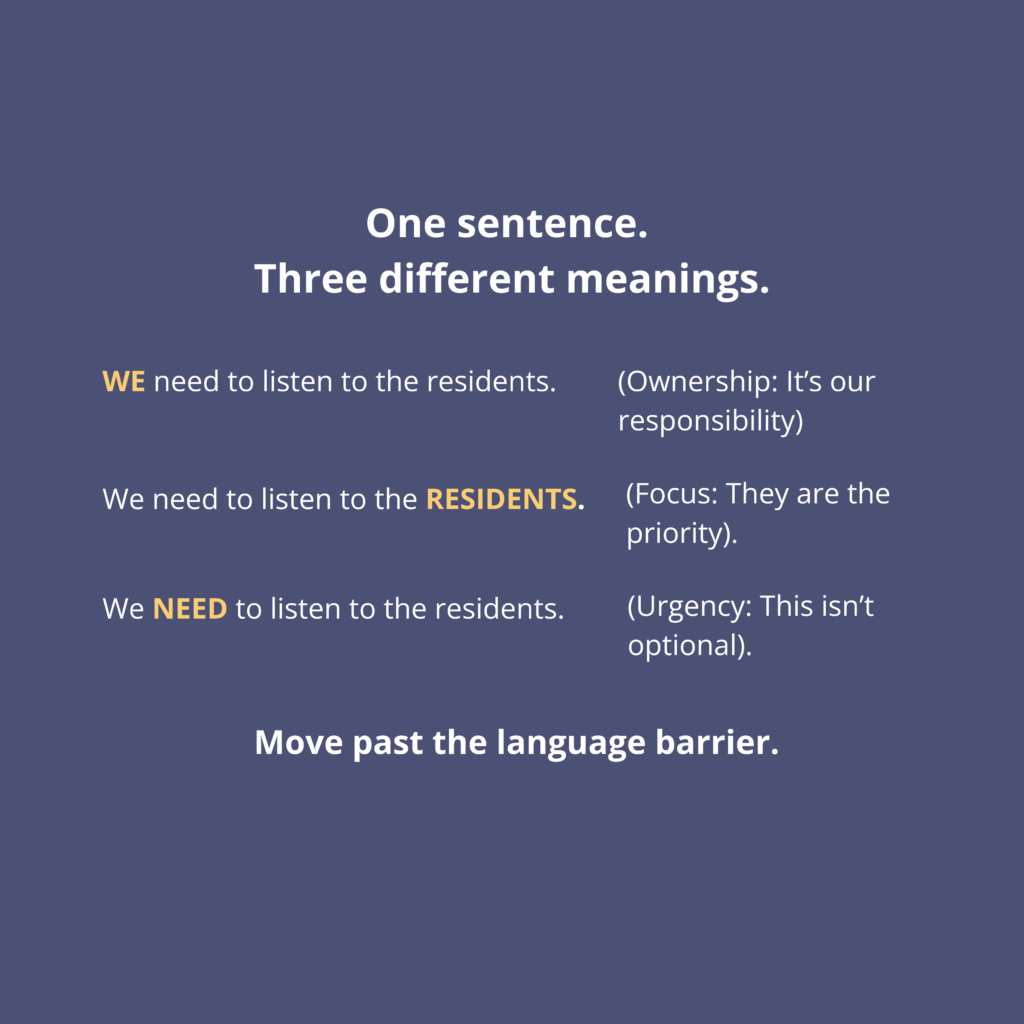
Think about this common sentence you might say in a meeting: “We need to listen to the residents.”
On paper, the meaning is flat. But in speech, where you place the stress (the emphasis) tells the room exactly what your priority is:
- Stress on LISTEN: “We need to LISTEN to the residents.”
- The Message: We’ve been doing all the talking; it’s time to stop and actually hear their feedback. (Focus: Engagement)
- Stress on RESIDENTS: “We need to listen to the RESIDENTS.”
- The Message: We’ve listened to the consultants and the board, but we’ve forgotten the people actually affected. (Focus: Accountability)
- Stress on NEED:“We NEED to listen to the residents.”
- The Message: This isn’t a “nice-to-have” suggestion; it’s a non-negotiable requirement for this project. (Focus: Urgency)
Why this matters for your career
As a second-language professional, using a flat intonation can sometimes make you sound less certain than you are. This can result in an Authority Gap.
By mastering word stress and nuanced vocabulary, you don’t just “speak English”, you signal your values. You ensure that when you speak up for a cause, the room understands exactly why it matters.
Book a Language Audit with WorkIt! today. Let’s make sure your expertise is heard.